Music Video Treatment vs Storyboard (2026)
A practical comparison of music video treatment vs storyboard: purpose, timing, ownership, level of detail, and handoff process.
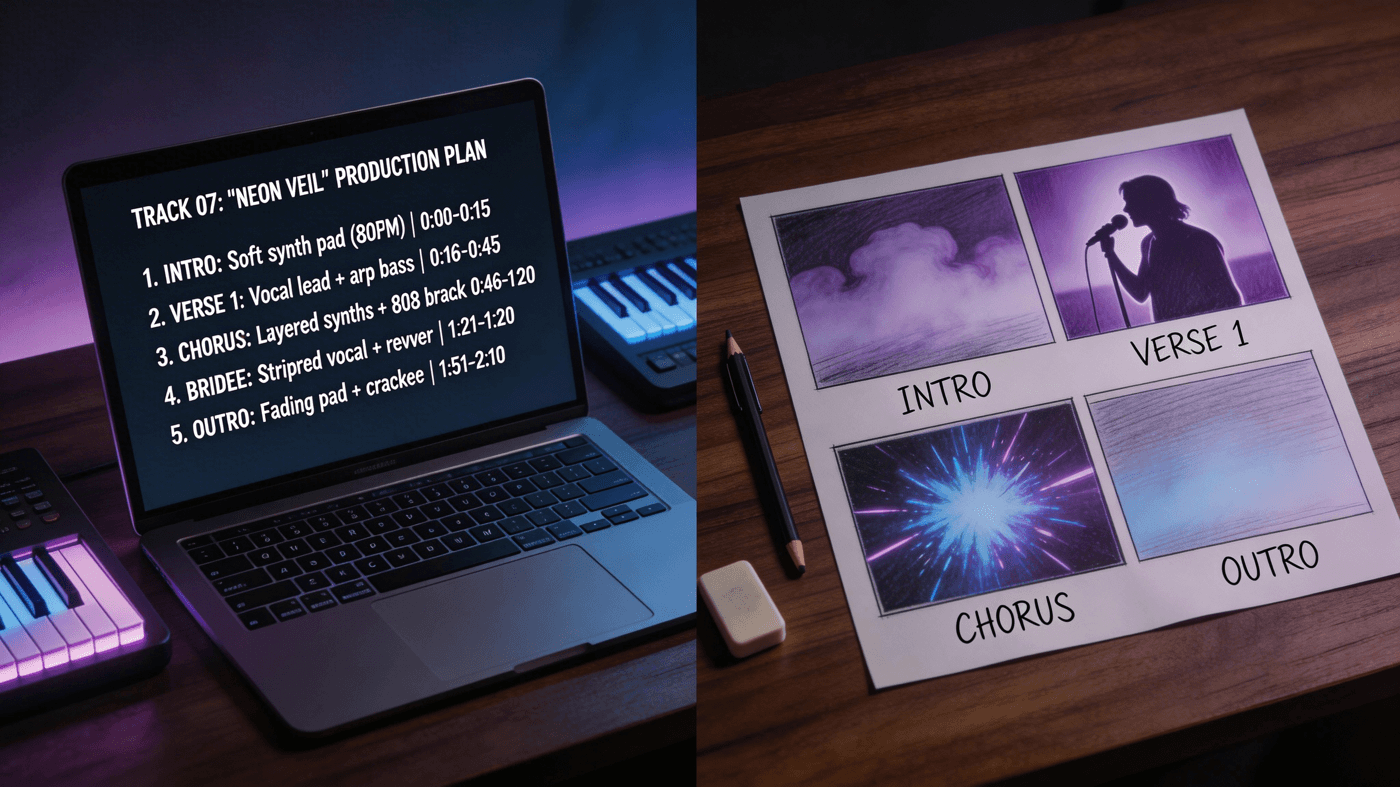
A music video treatment defines "what and why" — narrative intent, visual language, and creative direction. A storyboard defines "how and in what sequence" — frame-level camera behavior, transitions, and continuity. Treatments come first and cost less to revise; storyboards follow after treatment approval. AI can accelerate a first treatment draft, but the team remains responsible for creative intent, feasibility, rights, and final approval.
If your team keeps debating visuals late in production, you likely have a workflow problem, not a creativity problem.
Most often, that workflow problem is mixing up treatment and storyboard.
They are connected, but they are not interchangeable.
Key Takeaways
- Treatment is for decision alignment; storyboard is for execution alignment.
- Treatment answers "what and why"; storyboard answers "how and in what sequence."
- Approving storyboard before treatment alignment increases revision cost.
- Even small teams should keep both artifacts (lightweight versions are fine).
One-Sentence Definitions
- Music Video Treatment: a concise concept document that defines narrative intent, visual language, and progression. For a complete breakdown of what goes into a treatment, see What Is a Music Video Treatment?.
- Storyboard: a shot-level planning document that maps frames, camera behavior, and continuity.
Side-by-Side Comparison
| Dimension | Treatment | Storyboard |
|---|---|---|
| Main purpose | Align creative direction | Align production execution |
| Core question | What should this video be? | How exactly do we shoot/build it? |
| Detail level | Conceptual + structured | Shot-level + sequential |
| Typical audience | Artist, label, producer, director | Director, DP, editor, production team |
| Timing | Early (before budget commitment) | After treatment approval |
| Revision cost | Lower ($0-$500 typically) | Higher ($500-$5,000+ per revision cycle) |
| Typical length | 1-5 pages or slides | 10-60+ panels |
| Creation time | 2-8 hours (or minutes with AI) | 1-3 days |
| Format | Prose + references + mood boards | Illustrated panels + annotations |
| Approval stakeholders | Artist, label, management | Director, DP, producer |
Why This Distinction Matters
When teams skip clear treatment alignment, storyboard work becomes speculative. That usually causes:
- duplicated planning effort,
- schedule pressure,
- avoidable reshoots or heavy post fixes.
The earlier you settle direction, the cheaper execution becomes. As director Dave Meyers described his process with Missy Elliott in a Fortune interview, "It'll start with the song and then occasionally there's a nugget or two that she sees in her head... then I'll just kind of riff on that and build a whole context around it then pitch her a hundred ideas." This collaborative treatment process is what produces the creative vision that the storyboard then translates into specific shots.
Correct Workflow (Recommended)
Use this order (the standard music video pre-production pipeline as of 2026):
- Song Intent — clarify the emotional arc and target audience
- Treatment — align concept, visual language, and narrative direction
- Storyboard — plan shot-level framing, motion, and transitions
- Shot List — finalize what must be captured on set
- Production — execute the shoot or AI generation
Treatment Phase Deliverables
- logline,
- concept summary,
- visual language rules,
- phase-based scene progression,
- references with intent notes,
- basic constraints.
Use Music Video Treatment Template if needed.
Storyboard Phase Deliverables
- ordered frames/panels,
- framing scale and angle intent,
- movement notes,
- transition continuity,
- optional timing marks.
Example: Same Idea, Different Documents
Treatment version (direction)
"The video starts emotionally distant, tightens through internal conflict, then opens into release. Visual tone shifts from cool restraint to warm kinetic movement."
Storyboard version (execution)
- Shot 01: Wide static frame, subject center-left, low movement.
- Shot 02: Medium handheld push-in on line 2 of verse.
- Shot 03: Hard cut to overexposed backlight, silhouette profile.
- Shot 04: Match cut to chorus with 180-degree orbit motion.
Same creative idea. Different operational function.
Illustrative scenario: A label producing multiple music videos per quarter can compare workflows with and without treatment alignment. Projects that skip the treatment phase typically require more revision cycles and longer delivery timelines, because the team lacks a shared creative reference point. Treatment-first workflows tend to reduce back-and-forth significantly, as the director, artist, and label have already aligned on vision before any footage is shot or generated.
When Lightweight Is Enough
For indie teams, you can simplify both documents:
- 1-page treatment
- 10-20 panel keyframe storyboard
The goal is not bureaucracy. The goal is clarity.
Warning Signs You're Mixing Them Up
- Treatment has excessive lens/camera specs.
- Storyboard is full of abstract mood text.
- Stakeholders approve "look" but not progression.
- Production asks basic concept questions late.
If this happens, step back and re-separate artifacts.
Handoff Checklist: Treatment -> Storyboard
Before storyboard starts, confirm:
- Concept is approved by decision-makers.
- Visual language is explicit.
- Scene progression is stable.
- Reference intent is documented.
- Constraints are visible.
If any point is weak, revise treatment first.
Decision Rule: Should We Storyboard Yet?
Ask three questions:
- Can all stakeholders describe the same video in their own words?
- Are major visual disagreements already resolved?
- Is narrative progression stable enough to commit shot order?
If not, you're not ready for storyboard.
Get both: AI generates a treatment that feeds your full MV workflow
VibeMV's AI Treatment Generator turns your song into a structured draft in minutes. Start with the Music Video Treatment hub, then move into the AI music video generator once the concept is approved.
Final Thought
Treatments and storyboards are not rivals. They are sequential quality gates.
Use treatment to reduce ambiguity, then use storyboard to reduce execution risk.
Ready to start with the treatment step? VibeMV's AI Treatment Generator analyzes your song and generates a complete treatment in minutes -- so you can move into storyboard faster. Upload your song, describe your vision, and get a professional treatment with logline, visual style, mood board, and scene breakdown.
Create Your Treatment with AI ->
Frequently Asked Questions
What comes first: treatment or storyboard?
Treatment should come first to align concept and visual direction. Storyboard should follow after direction is approved.
Can I skip treatment if my team is small?
You can use a lightweight treatment, but skipping it entirely usually increases confusion and late-stage revisions.
What detail level belongs in storyboard?
Storyboard should include shot-level framing, motion intent, continuity, and transition logic needed for execution.
Why do teams confuse treatment and storyboard?
Because both discuss visuals, but they solve different problems: treatment aligns decisions, storyboard aligns execution.
Can AI tools replace the treatment step?
AI can accelerate a first draft, but it does not replace creative judgment. The team remains responsible for intent, feasibility, rights, and final approval.
Industry References
- StudioBinder: What Is a Storyboard
- Boords: How to Storyboard
- StudioBinder: How to Write a Film Treatment
Next reads:
More Posts
![10 Music Video Treatment Examples You Can Actually Use [2026]](/_next/image?url=%2Fimages%2Fblog%2F10-music-video-treatment-examples.png&w=3840&q=75 "10 Music Video Treatment Examples You Can Actually Use [2026]")
10 Music Video Treatment Examples You Can Actually Use [2026]
10 detailed, adaptable music video treatment examples with concept logic, scene progression, visual rules, references, and revision notes.
How to Make a Music Video Treatment in 60 Minutes
A fast, practical workflow to draft a first-pass music video treatment in 60 minutes, including timed steps, output checklist, and revision strategy.
How to Write a Music Video Treatment (2026)
Step-by-step framework to write a strong, review-ready music video treatment: concept clarity, visual language, reference logic, scene progression, and approval checklist.